Dr. med. Stefan Wagner, MHBA is an occupational physician (specialist for occupational medicine with industry and management experience), anesthesiologist, emergency physician, medical informatics specialist, health economist, consultant in agile software development and digital health/digitalization of healthcare, travel medicine specialist, Scrum Master, Product Owner, Team Kanban Practitioner (TKP), Agile Coach, Lean Six Sigma Green Belt, Design Thinking Professional, DevOps, OKR Master Certified Professional, OKR Champion Certified Professional, quality circle moderator, quality manager, Certified ISO/IEC 27001 Internal Auditor, Certified ISO 22301 Internal Auditor for Business Continuity Management (BCM), Innovation Management Certified Professional, researcher, visionary, keynote-speaker and author.
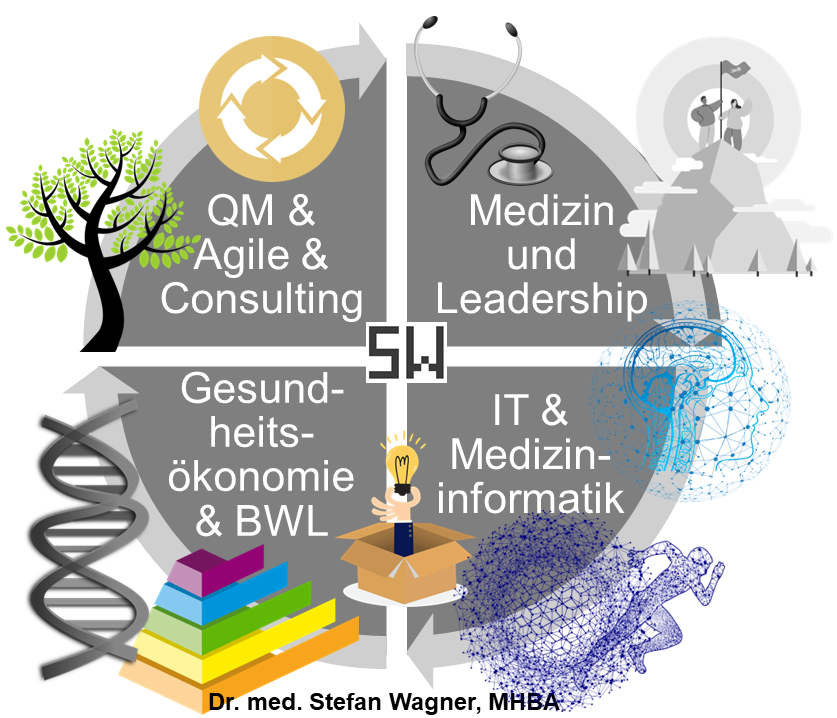
His unique selling point is the synergistic combination and successful hands-on application of experience and expertise from medicine (including occupational medicine, anesthesiology), IT, medical informatics, digital health, health economics, business administration, quality management, consulting, software development and agile methods.
As a specialist in occupational medicine and head of a steering committee for occupational health management (BGM), he has experience in occupational medical care in an industrial environment and in workplace health promotion (BGF). In addition, he leads as a leader & manager in the spirit of Positive Leadership.
In the area of Data Science, he is involved with Natural Language Processing and Image Segmentation in Python.
He regularly looks beyond his own nose into related fields and purposefully combines know-how, especially from medicine, telemedicine, IT, business agility, economics, QM and medical ethics. For him, economics and top performance are not contradictory.
In the field of travel medicine he is certified on the basis of both official DTG certificates Travel Medicine and Working in the Tropics.
He completed his further training in addiction medicine according to the curriculum of the German Medical Association and was awarded the additional title of addiction medicine basic care.
In addition to his respected research, for example on increasing the efficiency and process optimization of tumor documentation at a top oncological center, he initiated numerous other interdisciplinary projects in the context of medical informatics with a focus on anesthesia and occupational medicine, which he successfully managed and implemented.
As a consultant in agile software development and digital health Dr. Wagner provided support during the agile initial development and further optimization of occupational health software.
In addition, for the hospital sector, he has the authorization pursuant to Section 21 (5) Sentence 1 of the Hospital Structural Fund Ordinance (KHSFV), granted by the Federal Social Security Office (Bundesamt für Soziale Sicherung).
Customer focus and target group orientation are his guardrails as a requirements engineer. He reconciles the requirements of various interdisciplinary stakeholders and links them during the creation and refinement of product backlogs as a product owner. He brings digitalization and automation together. He wants to avoid media disruptions through a stringent single-source infrastructure.
IT process support in healthcare is his passion. Detailed evaluation criteria for efficient hospital information systems (HIS) were developed by him and validated in practice.
Due to his holistic perspective, he is also known as the author of several book contributions on medical ethics. In this context, he focuses on alleged conflicts of interest, globalization, value orientation and artificial intelligence. He shows generic solution possibilities in a precise and at the same time very descriptive way.
As a leader, Dr. Wagner leads through meaning and passion for goals and content. The further development and personal growth of people inspire him.
As head of a steering committee for corporate health management, he developed innovative concepts and successfully implemented them in practice as pilot projects, which served as a framework to complement individual health promotion actions and activities in order to achieve sustainable effects. Target group orientation is his key to success.
Many years of experience in industry, research and public service as well as in university and medical didactics round off his comprehensive profile in addition to his wide-ranging IT skills.